
Adair County Parole or Probation
Parole and probation can both place an Adair County person under Oklahoma Department of Corrections supervision, but they begin in different ways. Parole is conditional release from prison while the original sentence continues. Probation is a court-ordered term served in the community, often through a suspended or deferred sentence. Leaving prison on parole does not mean the sentence was discharged. Likewise, completing a jail stay does not prove that a probation term ended.
The distinction controls where to look. The Oklahoma Pardon and Parole Board considers parole and publishes hearing material, but ODOC supervises parolees. A sentencing court creates probation terms, while ODOC supervises many Oklahoma probationers. The Adair County court docket can show a suspended or deferred term, an application to revoke or accelerate, and a later discharge event. State records then help establish whether ODOC jurisdiction remains active.
| Question | Parole | Probation |
|---|---|---|
| How it begins | Conditional release from prison after the required decision and processing | A sentencing-court order for a community term |
| Who supervises | ODOC Probation and Parole Services | ODOC when the probation term is assigned to it |
| Useful records | ODOC status, PPB decision, parole certificate, release record | Judgment, probation order, ODOC status, discharge order |
| What ending means | Discharge must be documented; leaving prison is not enough | The court or supervising authority documents completion or discharge |
- Parole
- Conditional release from prison while the sentence and supervision continue.
- Probation
- A court-ordered community term that may follow a suspended or deferred sentence.
- Discharge
- The formal end of jurisdiction or a supervision term, as shown by the responsible authority.
- Absconder
- A person recorded as evading supervision, not a person who completed supervision.
Check Adair County Supervision
Begin with the official OK Offender Lookup. Use an ODOC number when available. A number narrows identity better than a name alone. If only a name is known, compare the displayed photograph, name, age or birth information, offense entries, location, and ODOC number before relying on the record. The portal covers ODOC incarceration and supervision. It will not necessarily contain a person whose Adair County case ended with county time, bond, dismissal, or a supervision arrangement outside ODOC.
Then compare the state result with the Adair County OSCN docket. The docket can reveal a suspended sentence, deferred term, probation order, revocation filing, acceleration filing, judgment, or discharge event. OSCN is not the official court record, so a certified copy must come from the Adair County Court Clerk. Court records establish legal action. They do not prove the exact day a prison gate opened or that every ODOC supervision step was complete.
- Collect the full legal name, aliases, date of birth if known, case number, and ODOC number.
- Search OK Offender Lookup and confirm identity from more than the name.
- Read whether the record points to incarceration, community supervision, or another ODOC status.
- Search the Adair County court docket for the judgment, supervision terms, violations, and discharge entries.
- Call the assigned ODOC office with the ODOC number and ask whether the person is routed there and whether supervision is active. Staff may withhold case-plan details.
- For durable proof, request the relevant supervision, parole, release, or discharge document from the responsible agency.
For a broader custody and release chain, the Adair County released-inmate search explains how jail, court, ODOC, and transfer records fit together.
Note: No separate current public statewide probation-only lookup was confirmed, so office and court verification remain important.
Adair Supervision Routes to Tahlequah
Adair County does not route its assigned ODOC supervision work through an office in Stilwell. The county-office table assigns Adair and Cherokee Counties to the Tahlequah Probation and Parole Office. This neighboring-county arrangement is the direct local route for a case already identified as ODOC supervision. Call with the person’s full name and ODOC number. Ask whether the case is assigned to that office and whether staff can confirm active supervision. Confidentiality rules may limit an answer about conditions, schedules, reports, treatment, or other case-plan facts.
ODOC Tahlequah Probation and Parole
311 South Muskogee Avenue
Tahlequah, OK 74464
Phone: 918-456-9921
Fax: 918-456-5275
The ODOC Probation and Parole Services page supplies the official office route. The office verifies supervision, not whether an Adair County Jail booking ended at a certain hour. County-jail release proof must still come from the jail movement or release record. A state parole matter, by contrast, needs the later ODOC record even when a parole-board result is favorable.
The official ODOC service page shown below is the source for the supervision route.
View ODOC probation and parole services before relying on an old office directory.
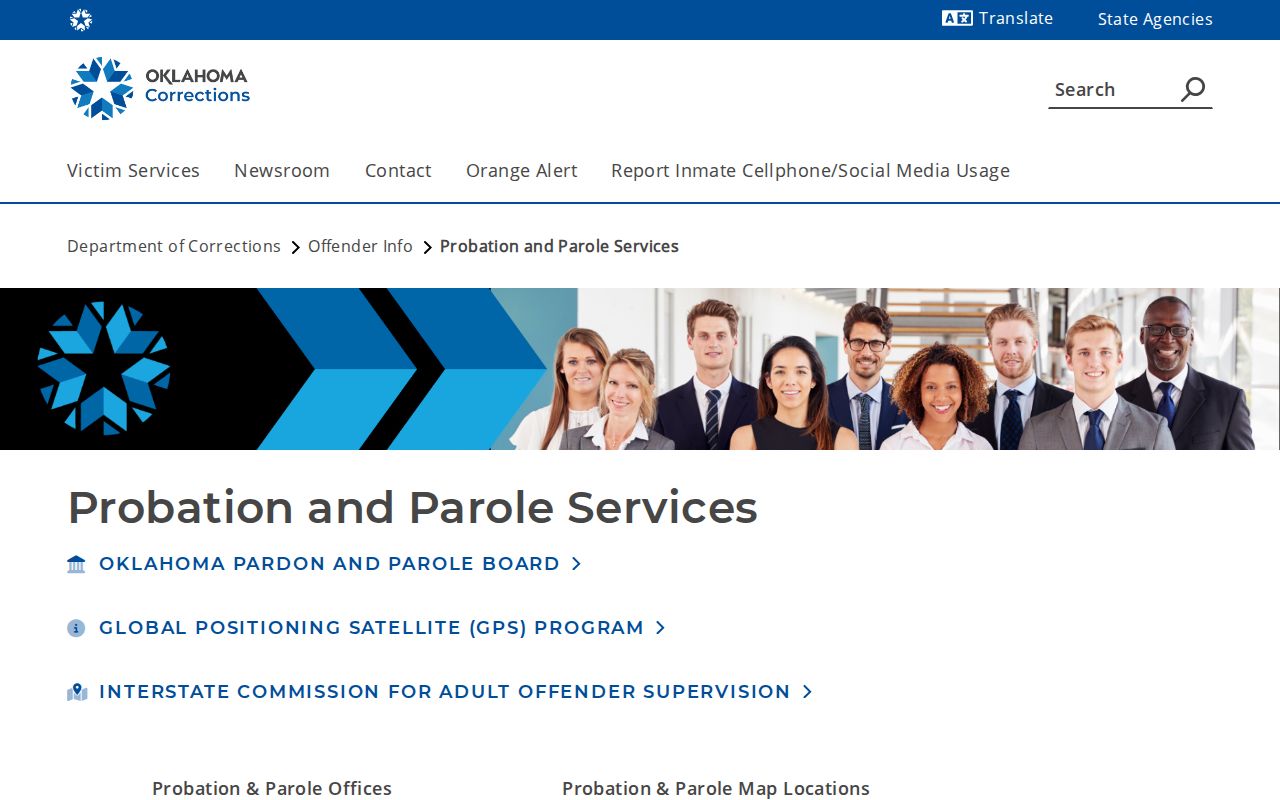
The page identifies ODOC as the supervision agency, which prevents confusion with the separate Oklahoma Pardon and Parole Board.
Adair Parole Decisions and Release
The Oklahoma Pardon and Parole Board publishes a current meeting calendar plus monthly dockets and results. Search a docket by name or ODOC number, then match it with the result for that meeting. A docket shows that consideration was scheduled. A result shows Board action after the vote is validated. Neither record, standing alone, proves that ODOC physically released the person.
Outcome words must retain their precise meaning. A grant in a nonviolent matter is a Board action that still requires ODOC processing. A favorable result in a violent case is a recommendation to the Governor, not final release. A pass sends consideration to another docket. A denial means that hearing did not produce a parole grant. Deferred, stricken, rescinded, and other administrative movements also must not be rewritten as release or discharge.
After a favorable outcome, check later ODOC status and request the applicable parole or release document. The PPB decision and ODOC movement record answer different questions. The first records the Board action. The second establishes whether release from prison later took place. Even then, parole remains supervised release for the balance of the sentence and is not full discharge.
Note: Board votes are not final until the last meeting day ends and the action has been validated.
Adair Supervision Violations and Absconders
Conditions vary by judgment and case plan, so broad descriptions should not be treated as a person’s actual terms. Common supervision records can concern reporting, approved residence, travel, fees, treatment, testing, electronic monitoring, or compliance with special court terms. The court docket may show an application to revoke a suspended sentence or accelerate a deferred sentence. ODOC records may show a change in supervision status. The supervising office is the source for the subject’s current instructions.
An absconder is someone recorded as evading supervision. It does not mean that parole or probation ended. ODOC maintains an official fugitive and absconder search. A result should be matched by ODOC number and identifiers, then confirmed with ODOC because warrants and status entries can change. Research policy calls for a confirmed absconding movement to be entered by the next working day, but that internal rule is not a promise that every public screen updates at once.
A violation allegation is not itself final proof of revocation. Follow the court or administrative proceeding through its result. If custody follows, identify the custodian rather than assuming the person returned to the same facility. Adair County Jail, an ODOC facility, another county, or another authority may hold the person depending on the warrant and case.
Adair Discharge Records and Identity
Supervision ends through a documented discharge or other lawful termination, not by the passage of a guessed date. ODOC policy keeps a record active through incarceration and supervision. When jurisdiction ends, the file moves through closing steps toward Closed Records. Useful document targets include a Certificate of Release, Notice of Inmate Status Change, parole certificate, and discharge-status record. Closed Records can be reached at 405-425-2691, while ODOC provides an online open-records form.
ODOC policy adds a practical detail at state discharge. Original identity documents held in the legal file are returned to the former offender. The listed examples include a birth certificate, Social Security card, state identification or driver license, passport, military record, Certificate of Degree of Indian Blood, tribal photo identification, and a qualifying school identification card. This policy applies to ODOC discharge. It must not be attributed to Adair County Jail, where no matching property or document-return rule was verified.
A former offender may also ask ODOC Closed Records to review the file and challenge inaccurate ODOC information. Policy states that review should be available within 30 days. If the disputed fact came from the sentencing judgment, the court must address it. ODOC generally retains a commitment name and adds a later legal name as an alias unless the sentencing court changes the judgment. That explains some search mismatches without proving the record belongs to someone else.
Closed Records review is a records-accuracy route. It does not erase a valid sentence or replace an expungement order. Keep the disputed field, ODOC number, court document, and written response together so the correction can be traced. When the source is a VINE display, seek correction from the agency that supplied the custody data. When the source is OSCN, compare the filed document and request the official copy from the Adair County Court Clerk.
Note: Parole ends confinement before discharge, while probation completion and ODOC jurisdiction must be verified from the responsible record.