
Adair Projected Versus Actual Release
Oklahoma uses the term “Projected Release Date,” often shortened to PRD, for ODOC’s estimate of when an offender may be released. The Oklahoma Pardon and Parole Board does not calculate that date. ODOC calls it tentative. A projection can move before the person leaves custody. An actual release date records a completed event and should identify the custodian, time, disposition, and destination.
Dates elsewhere in a case have different meanings. An arrest date, booking date, court order, bond posting, judgment date, prison reception, parole grant, PRD, sentence expiration, and discharge date are not interchangeable. A court can authorize release before staff process the person. Another hold can prevent community release. A parole grant can precede ODOC’s physical movement. Put the source and date label beside each value.
- Projected Release Date
- ODOC’s tentative estimate based on the current sentence and credit calculation.
- Parole eligibility
- A point when consideration may occur, not a promise of release.
- Actual release
- The completed departure recorded by the custodian.
- Discharge
- The formal end of the authority’s jurisdiction, which may occur after release from confinement.
Adair Custody Sets the Date Source
A pretrial detainee at Adair County Jail usually has no sentenced release date to calculate. The court may set bond, release the person on recognizance, dismiss charges, or issue another order. Even then, jail staff must receive and process that authority and check for other holds. The Adair County OSCN docket can show the legal event, but the jail’s movement record supplies the actual exit time and whether the person went home or to another custodian.
A person serving a county-jail sentence may have a sentence endpoint, jail credit, or later court action in the case file. No Adair-specific public calculator, release calendar, weekend rule, or local earned-time policy was verified. Call Adair County Jail at 918-696-2106 and use the court record. Do not import a release practice from another Oklahoma county.
An ODOC-sentenced person belongs in the state sentence system, even if state reception is delayed and the person remains in county jail for a time. The official ODOC projection uses state law, sentence records, earned credits, and restrictions. A person who appears under community supervision has left institutional confinement but may still be under the sentence. Full discharge is another record.
| Situation | Primary date source | Key limit |
|---|---|---|
| Adair pretrial detention | Court order plus jail status | No fixed sentence release date may exist |
| Adair county sentence | Jail record and sentencing docket | No verified public local calculator |
| ODOC sentence | ODOC records and available public profile data | PRD is tentative and exact future details may be confidential |
| Parole consideration | PPB docket/result plus later ODOC status | A Board action is not physical release |
Find an Adair Release Date
Start with identity and jurisdiction. Collect the full legal name, aliases, date of birth if known, case number, booking number, ODOC number, sentence county, and last known custodian. Searching every portal without that step can merge different people or mix county and state cases. An ODOC number is the strongest public state-search key when available.
For a state case, open OK Offender Lookup, accept its disclaimer, and compare the photograph and identifiers before reading the record. ODOC says the presentation is abbreviated and not an exact account of the offense, sentence details, or time to be served. A public screen can aid identification and navigation, while the underlying sentence and release documents control formal proof.
- Identify whether Adair County Jail, ODOC, or another authority has the person.
- For the county jail, call with the booking or case details and ask whether a sentenced date exists.
- Read the Adair County court docket for judgment, jail credit, sentence changes, bond, or release orders.
- For ODOC, search by ODOC number and verify the photo, name, age or birth detail, offense entries, and status.
- Label any public Projected Release Date as tentative and record the lookup date.
- After the projection, reopen ODOC status and request the release or discharge document if proof is needed.
The Adair County released-inmate record path supplies the broader method for tracing a jail departure or transfer after the date arrives.
Note: A current jail roster is for people still held and is not an archive of completed Adair County releases.
Adair PRD Is Tentative
ODOC’s offender-information guidance says a particular inmate’s exact future release date is confidential unless the requester has a legitimate judicial, law-enforcement, or comparable need. The inmate receives days remaining and can work with a correctional records officer or case manager. Public users should not calculate a supposedly exact discharge date from the sentence alone.
This Oklahoma rule is especially important when a portal or copied record displays a projection. The visible value must not be presented as confirmed release. Earned-credit level, achievement credits, program performance, misconduct, restored credits, sentence amendments, jail credit, concurrent or consecutive terms, detainers, rebills, and statutory restrictions can all affect the calculation. A portal change after the capture date does not by itself prove error.
The worksheet governing the process is an ODOC administrative tool. It models several placements and warns that restricted-credit sentences can fall outside ordinary projections. The public value, when available, is best treated as a dated estimate and paired with ODOC’s confidentiality warning. If no exact future date is public, contact the authorized agency route rather than guessing.
Note: ODOC calculates a Projected Release Date; the Pardon and Parole Board does not set or confirm the PRD.
Adair ODOC Earned-Credit Rules
57 O.S. §138 provides Oklahoma’s earned-credit framework. Unless another law restricts credits, one credit equals one day deducted from the state term. Credit class, work assignment, program performance, offense history, and conduct matter. Attendance alone does not guarantee credit. Misconduct or nonperformance can lead to loss, and restoration follows policy rather than occurring by default.
| Credit class | Current monthly amount in research | Qualification note |
|---|---|---|
| Class 1 | 0 days | No monthly earned-credit reduction |
| Class 2 | 22 days | Assignment and satisfactory performance matter |
| Class 3 | 33 or 45 days | Amount depends on the statutory offense-history category |
| Class 4 | 44 or 60 days | Amount depends on the statutory offense-history category |
An ODOC-sentenced person held at a county jail because state reception is delayed begins earning applicable statutory credits from the judgment-and-sentence date, subject to the statute’s misconduct exception. That rule does not make the Adair County roster an authoritative PRD calculator. ODOC must apply the state sentence and credit framework.
The matching capture of 57 O.S. §138 shows the official source used for the earned-credit rules.
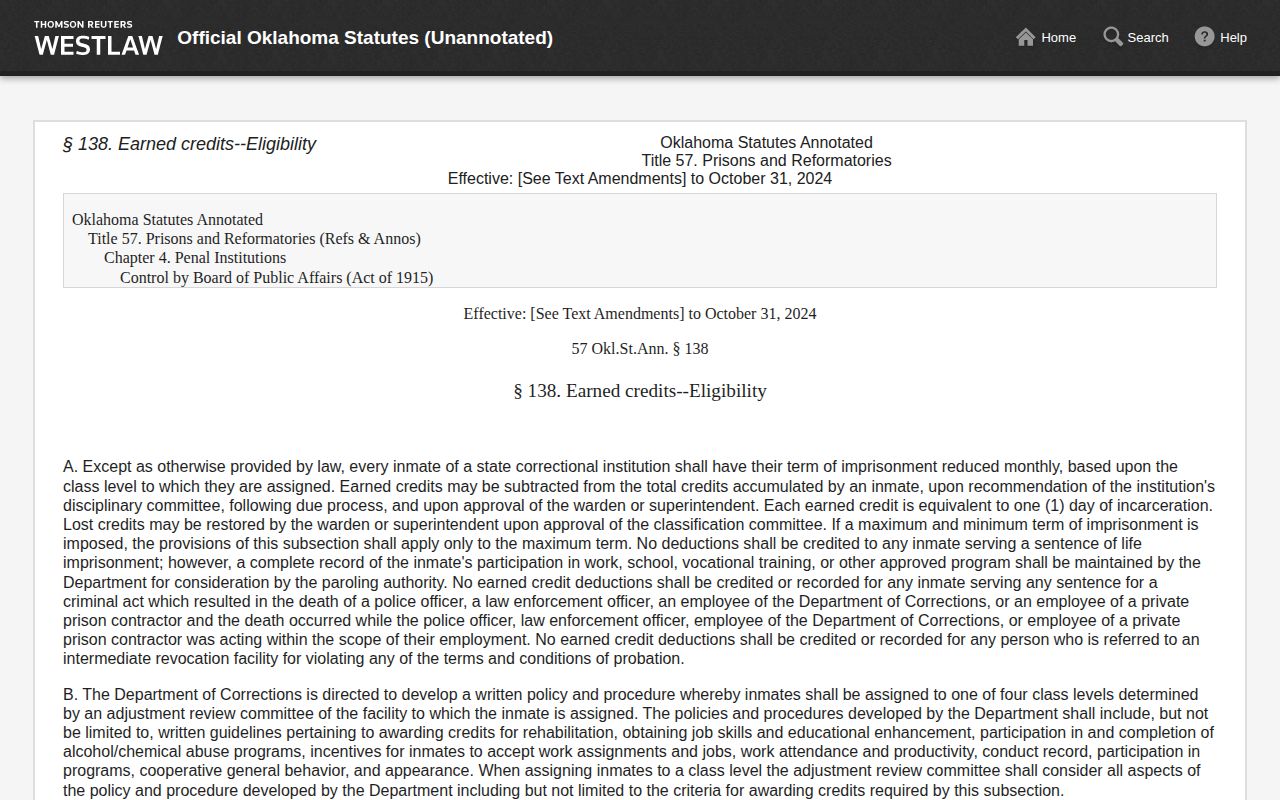
The statute supplies the framework, but an individual PRD still depends on ODOC’s current sentence computation and restrictions.
Adair Release Dates and 85 Percent
21 O.S. §13.1 creates Oklahoma’s offense-specific 85 percent rule. A person convicted of an offense listed in the current statute must serve at least 85 percent of the term of imprisonment before parole consideration. Credits cannot reduce confinement below that statutory floor. The rule does not apply to every felony, and it must not be reduced to a claim that all violent offenders serve the same share.
The exact judgment, offense, offense date, sentence date, and current statute matter. Attempts, conspiracies, and solicitations covered by current law can also affect the result. Laws change. The live provision and judgment should be read together. A general benchmark for a nonviolent parole consideration date is also not a release promise, since mandatory terms, exclusions, later sentence events, and PPB action remain relevant.
The official 21 O.S. §13.1 statute page is preserved in the successful projected-release manifest image.
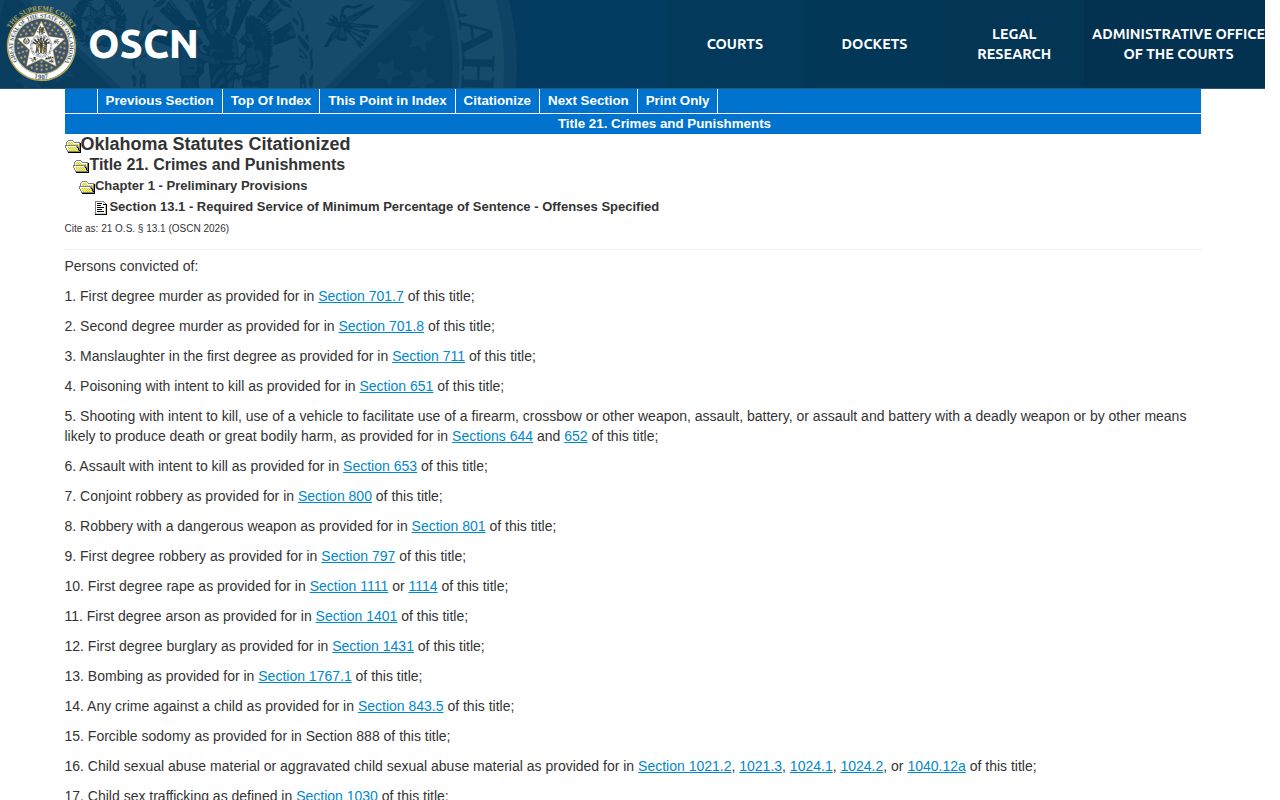
The statute image supports checking the listed offense rather than applying an 85 percent assumption to every Adair County case.
What Changes Adair Release Dates
A projection is a live computation. Changes can add or subtract time, alter the legal endpoint, or keep a person in custody after one sentence would otherwise end. The cause must be tied to a record rather than inferred from a date moving on a screen.
| Factor | Possible effect | Best record to check |
|---|---|---|
| Earned-credit class or achievement | Changes the credit rate or adds authorized credits | ODOC sentence and credit record |
| Misconduct loss or restoration | Moves the estimate later or earlier | ODOC disciplinary and credit record |
| Jail credit or amended sentence | Changes the time credited or term imposed | Court order plus ODOC computation |
| Concurrent or consecutive terms | Changes how multiple sentences run | Judgments and ODOC sentence ledger |
| Detainer or another hold | May prevent community release or cause transfer | Custodian and receiving-agency records |
| Parole action | May create a route to conditional release | PPB final result and later ODOC movement |
A detainer is a request or hold from another authority. If Adair County Jail or ODOC releases a person to another county, federal agency, tribal authority, or immigration authority, physical custody continues elsewhere. That is not a community release. Ask for the receiving agency and follow that record.
Adair Parole Dates Are Different
Parole eligibility, a parole-board meeting, and a PRD are separate. The Oklahoma Pardon and Parole Board publishes dockets and results, but it does not calculate the projected date. A scheduled hearing shows only that consideration was placed on a docket. A favorable violent-case outcome is a recommendation to the Governor. A nonviolent grant is still followed by ODOC processing and any required conditions.
A Board result must never be treated as the physical release event. After action, reopen the ODOC profile and determine whether it shows institutional custody, community supervision, or a later status. When exact proof matters, request the PPB action and the ODOC Certificate of Release, parole certificate, or other movement record. Parole ends prison confinement conditionally while the sentence and supervision continue. It is not full discharge.
Once the projected date arrives, the Adair County VINELink release check can provide an added custody-change alert. VINE still depends on source reporting and does not supply parole-hearing notice. Direct ODOC confirmation remains the stronger route.
Verify Adair Release After PRD
Reopen the ODOC record after the estimate. Determine whether the person remains in an institution, appears under community supervision, or has a status that requires agency explanation. If the projection passed while custody continues, check earned-credit changes, misconduct, multiple sentences, sentence amendments, holds, and source-update timing before drawing a conclusion.
For durable state proof, use ODOC’s open-records form or contact Closed Records at 405-425-2691. Identify the name, ODOC number, date of birth if known, Adair County case, and the specific Certificate of Release, Notice of Inmate Status Change, parole certificate, or discharge-status record sought. Restricted parts may require the subject’s authorization.
For an Adair County Jail case, ask the jail for the actual admission and release times, disposition, authority, and receiving agency if transferred. Compare that movement with the court docket. The court explains why release could occur. The jail record shows when and where the person moved. Together they are stronger than a calculated date or missing roster name.